

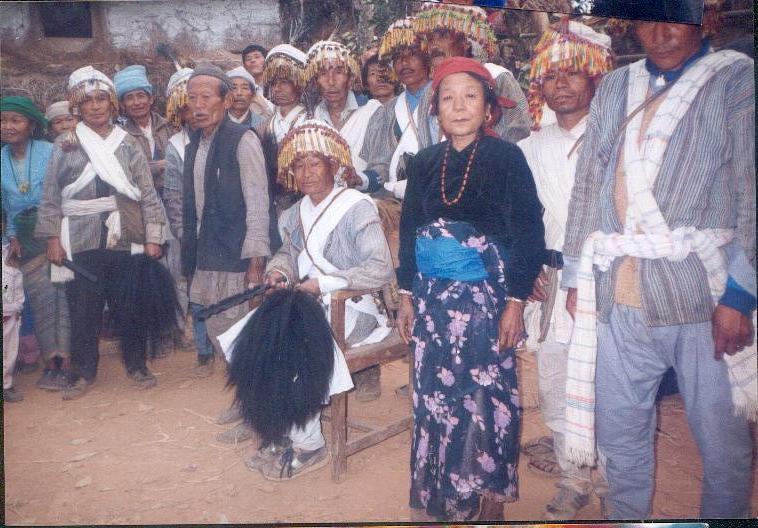
Nepal has been home to various indigenous ethnic communities since ancient times. The Kirat Rai are one of them. They are members of the Kirat community, which includes Rai, Limbu, Sunuwar, and Yakkha. The Rai are a multilingual and multicultural ethnic group.
After the victory of the Lichhavi dynasty, they moved eastward from the Kathmandu Valley and began to settle permanently in the hilly regions there. Their main homeland is known as Khambuwan or Majh Kirat, which includes the districts of Solukhumbu, Udayapur, Okhaldhunga, Khotang, and Bhojpur. These areas lie between the Sunkoshi and Arun rivers.
Apart from these districts, Rai people are also found sparsely settled in eastern regions such as Sankhuwasabha, Dhankuta, Taplejung, Panchthar, and Ilam. Outside Nepal, they are found in Sikkim, eastern Bengal—especially in the Darjeeling area—and in Assam. Some Rai people have also settled in Bhutan.
According to the national census of 2001, the population of Rai people was 636,151, which is 2.79% of Nepal’s total population. One of the interesting and unique features of the Rai community is that they have more than 30 clans, and each clan has its own mother tongue.
Each clan also has its own sub-clans. Because of these distinct mother tongues, the customs and traditions of the Rai people naturally show some variations. Some of the Rai clans include Bantawa, Chamling, Dumi, Khaling, Kulung, Lohorung, Thulung, Sotang, Koya, Sampangi, Athpahariya, and others. Due to various reasons, some Rai languages have already disappeared or are on the verge of extinction. The Rai languages belong to the Tibeto-Burman language family. Although rich, these languages do not have their own script and have survived orally for hundreds of years.
In terms of religion, the Kirat Rai follow rituals, traditions, and religious practices described in their sacred text called Mundhum. They have been practicing their religion since before the arrival of Hinduism and Buddhism. They worship Paruhang and Sumnima as their supreme god and goddess. The Kirat Rai are essentially nature worshippers. They worship the sun, moon, air, fire, trees, stones, mountains, rivers, and animals.
After the Gorkhali conquest, Hinduism was imposed on them, and its influence can still be seen in their social and religious practices.
An important cultural and religious element of the Kirat Rai is the “chulo” (hearth). From birth to death, all social and religious rituals are performed at the hearth. It is the center of their society and also a symbol of their religious identity. Hence, there is a saying: “Ten Rai, ten languages, but one hearth.”
Another important aspect of their religion is “Mang.” Mang is the supreme, omnipresent, formless power and the creator of the universe, who governs all existence. In any social or religious activity, the Kirat Rai invoke Mang at both the beginning and the end.
Like other rural communities, agriculture is the traditional occupation of the Kirat Rai. Many Rai youths are also employed in Indian and British Gurkha military services, which has significantly supported and improved their economic condition. Some are also found serving in Nepal’s army and police.
The biggest festival of the Kirat Rai is Sakela or Chandi dance. It is celebrated twice a year. The Ubhauli (first Sakela) begins on the full moon of Baisakh, marking the agricultural season, while the Udhauli (second Sakela) starts from the full moon of Kartik–Mangsir, symbolizing the harvest season. During this joyful occasion, people sing, dance, eat, and celebrate together. Traditional drums and cymbals are played during the dance, and in some places, the festival lasts for several days.
The Kirat Rai also celebrate Dashain and Tihar. However, in recent times, some Kirati communities have begun boycotting Dashain, stating that it is not an indigenous Kirati festival, while others continue to celebrate it.
