

Background
In every country of the world, people celebrate festivals. Every ethnic group, religion, custom, and tradition has its own festivals, each with its own dignity and importance. Festivals developed through the repetition and remembrance of significant historical events in the course of social development. They are not only for entertainment but also serve to preserve the glorious history of a community and inspire collective unity and cooperation for common well-being.
For example, the Hindu festival Dashain (Vijaya Dashami) is based on the victory of gods (devas) over demons (asuras), symbolizing the dominance of Hindu-Aryan traditions. Similarly, Christians celebrate Christmas on the birth of Jesus Christ, Muslims celebrate Eid on the birth of Prophet Muhammad, Buddhists celebrate Buddha Jayanti on the birth of Gautam Buddha, Tibetans celebrate Losar as the New Year, and Hindus in Nepal celebrate Bhai Tika (Tihar) for the longevity of brothers. Other festivals include Holi (Fagu), Gaijatra in Newar culture, and Chhath in the Terai region.
Among these diverse cultural traditions in and outside Nepal, the Khambu Rai Kirati people have their own traditional festivals such as Sakewa (celebrated during the planting season) and Chachowa/Nwagi (celebrated during harvest time).
Therefore, Sakewa is a great festival of the indigenous Khambu Rai Kirati people. It not only represents them but also preserves their ancient history and contributes to enhancing Nepal’s cultural identity. Since such indigenous cultures exist only in Nepal, preserving them is essential not only for the community but for the dignity and history of the entire nation.
However, after Nepal’s unification, discriminatory Hindu-centric policies prevented other cultures from flourishing equally. The ideology of “one nation, one religion, one language” promoted cultural domination and forced Hinduization and linguistic imposition. As a result, many indigenous cultures faced extinction or crisis.
Even in the present democratic era, problems such as inequality, poverty, unemployment, illiteracy, disease, cultural discrimination, displacement, destruction of traditional skills, western cultural imitation, and political neglect have endangered the languages, religions, and traditions of Kirati people.
Therefore, immediate protection and preservation of these cultural heritages is essential; otherwise, the cultural identity of Kirati people and Nepal’s national dignity may be lost.
Introduction to Sakewa
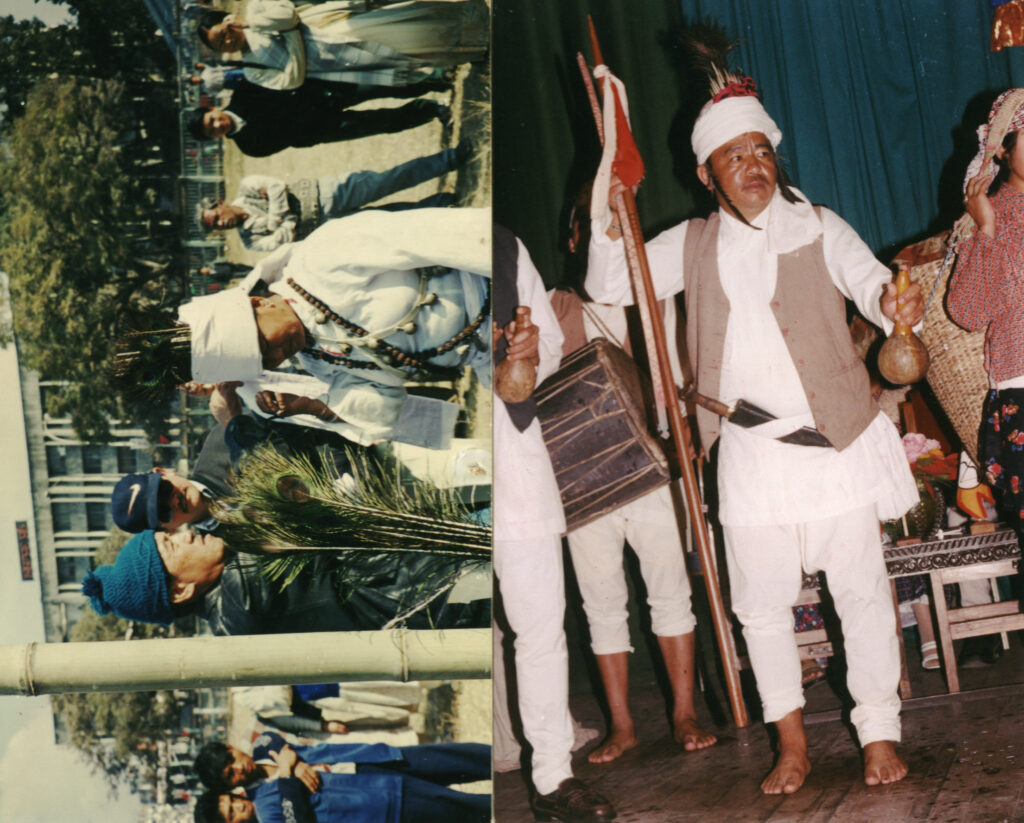
Sakewa is a major festival of the indigenous Khambu (Rai) Kirati people of Nepal. It is traditionally celebrated in the regions of Bhojpur, Okhaldhunga, Khotang, Udayapur, and Solukhumbu.
Different Kirati groups know it by different names:
- Sakewa / Sakenwa (Bantawa)
- Sakala / Sakewa (Chamling)
- Sakle / Tosh (Thulung)
- Bhume Puja (Kulung)
- Chandi (in some regions)
Although there is no precise historical record of its origin, oral traditions suggest that Sakewa dates back to the early Kirat civilization. Kirati people believe in Paruhang and Sumnima as the first creators and worship ancestral spirits along with natural forces like earth, sky, sun, water, and trees.
Since agriculture is their main livelihood, Kirati people worship these natural and ancestral powers during Ubhauli (planting season) and Udhauli (harvest season) for prosperity, good harvest, and harmony.
During the festival, offerings such as rice, ginger, alcohol (traditional), fish, and animal sacrifices are made, followed by dancing, singing, and communal feasting in circular formations.
Importance of Sakewa
Sakewa has multiple significance:
- Historical: Reflects ancient Kirati civilization and lifestyle.
- Social: Strengthens unity, friendship, and relationships among people.
- Economic: Encourages agricultural production and skill development.
- Cultural: Preserves traditions, music, dance, and identity.
- Religious: Worship of ancestors and nature for spiritual fulfillment.
- Physical: Dance and participation improve health and energy.
Ritual Process
Sakewa rituals are performed by traditional Kirati priests such as Nakchhong, Samba, or Wangpa Mangpa, not by Brahmin priests.
It has three main stages:
1. Hutlung (Initial Ritual)
Priests visit households with drums and perform household worship (chula puja).
2. Main Sakewa Worship
A central ritual is performed at a designated sacred place for community welfare and prosperity.
3. Seuli Ritual (Conclusion)
Participants carry symbolic plants (seuli), dance from house to house, and conclude the festival with feasting and celebration.
Sakewa Silly (Dance Forms)
Sakewa dance is a ritual circular dance performed with drum and cymbal rhythms by men and women together.
It is divided into three types:
1. Animal and Nature Imitation Dance
Imitates birds and animals such as chicken, bear, tiger, crane, etc., showing early human connection with nature.
2. Agricultural Dance
Depicts farming activities such as clearing land, planting seeds, harvesting, grinding grains, etc.
3. Cultural and Daily Life Dance
Represents daily activities like cooking, weaving, dressing, greeting, and celebration.
Conclusion and Suggestions
Sakewa is a living cultural heritage of the Kirati people and represents Nepal’s ancient civilization. However, due to external influence, neglect, and modernization pressures, it is gradually declining.
To preserve it, the following steps are suggested:
- Systematic research and documentation of Sakewa
- Preservation of historical Sakewa sites
- Encouraging Kirati people to celebrate in ancestral regions
- Establishing traditional household worship practices
- Cultural awareness among youth
- Training cultural leaders in villages
- Respect and support for traditional priests
- Recognition of Sakewa as a national festival with public holiday
Finally, on the auspicious occasion of Sakewa 2052, we extend best wishes for peace and prosperity to all and appeal to everyone—both inside and outside the country—to participate in preserving this ancient cultural heritage of Nepal.
Thank you.
