

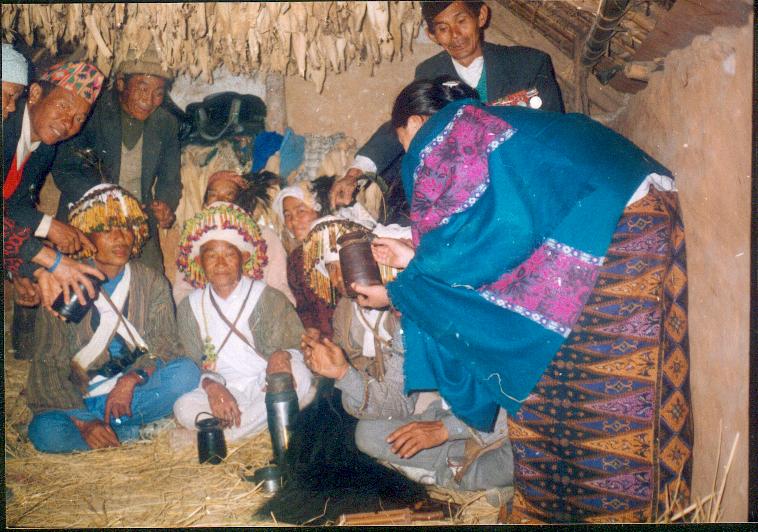
Nepal is a very ancient country. In the past, it was ruled by many dynasties, among which the Kirat period is considered very important because it was the longest ruling era. This period began in the pre-historic age and continued into the historic period. Ancient Hindu scriptures mention Nepal as “Kirat Desh” (the land of the Kirats).
The Kirats were indigenous people of Mongolian origin. They were generally strong, short in stature, with prominent cheekbones, flat noses, small black eyes, and sparse facial hair. They were brave and courageous warriors, highly skilled in archery.
Before the arrival of the Kirats, King Bhuvan Singh ruled the Kathmandu Valley. The first Kirat king, Yalambar, defeated him and established Kirat rule. This rule lasted until around 1225 years. After establishing dominance in the valley, the Kirats made Matatirtha their capital. During Yalambar’s reign, the Kirat kingdom extended from the Tista River in the east to the Trishuli River in the west.
According to a legend, King Yalambar went to observe the Mahabharata war between the Kauravas and the Pandavas. He was so powerful that Lord Krishna feared he might support the Kauravas, so Krishna beheaded him before the war began. Today, the Kirats revere him as a divine king.
William Kirkpatrick mentioned in his chronicles that the Kirat period lasted from around 900 BCE to 300 BCE. During this long period, 29 Kirat kings ruled. These kings were:
- Yalambar
- Pabi
- Skandhar
- Balamba
- Chhiti
- Humti
- Jitedasti
- Galinja
- Pushka
- Suryama
- Papa
- Bunka
- Swananda
- Sthunko
- Jinghri
- Nane
- Luka
- Thor
- Thoko
- Barma
- Guja
- Pushkar
- Keshu
- Saja
- Sansa
- Gunam
- Rivambhu
- Patuka
- Gasti
During the reign of the seventh Kirat king Jitedasti, Lord Gautam Buddha visited the Kathmandu Valley with many disciples. He visited sacred places such as Swayambhu and Shyambhu and delivered religious teachings. Although the Kirats did not adopt his teachings, they warmly welcomed him.
Around 250 BCE, during the reign of the fourteenth Kirat king Sthunko, Emperor Ashoka of India visited Nepal. He had inscriptions carved on rocks and erected a stone pillar, which is still known today as the Ashoka Pillar. Dr. Fuhrer rediscovered this pillar in December 1895. The Government of Nepal has since developed Lumbini as a major religious tourism site.
Emperor Ashoka also visited the Kathmandu Valley during his pilgrimage, accompanied by his daughter Princess Charumati. He built four stupas in the four directions of the valley and one in the center of Patan. These structures confirm his historical visit. Charumati later married a local prince named Devpal and lived in Chabahil near Pashupati. After her husband’s death, she founded a town called Devapatan in his memory and became a nun, constructing a monastery to practice Buddhist teachings.
During the tolerant rule of the Kirats, Buddhism entered Nepal. Around the same time, Jainism, founded by Mahavira in India, was also spreading. Around 300 BCE, Mahavira’s disciple Bhadrabahu visited Nepal during the reign of the seventeenth Kirat king Jinghri, but Jainism did not become as popular as Buddhism.
Later, during the reign of the twenty-eighth king Patuka, the Somavanshi rulers attacked from the west. Although Patuka successfully defended against them, he moved to Gokarna and Shankhamul, where he built a palace. Today, only ruins remain. He also developed Shankhamul into a town.
The last Kirat king was Gasti, who proved weak. He was defeated by Somavanshi king Nimesh, marking the end of the Kirat rule, which had lasted around 1225 years. After their defeat, the Kirats moved to the eastern hills of Nepal and settled in smaller states. Their regions were divided into three areas: Wallo Kirat (near Kathmandu), Majh Kirat (central eastern hills), and Pallo Kirat (far eastern region). Even today, Kirat populations are prominent in these areas.
Kirat Civilization and Culture
The long rule of the Kirats shows that they were a strong and well-organized society. Their administrative system and economy were well developed. The Lichhavis, who came later, respected and preserved many Kirat traditions.
The Kirats had influence not only in the Kathmandu Valley but also in eastern regions. Even today, many hills and rivers have names derived from Kirat languages.
Their society was free and liberal, with no gender discrimination. To ensure justice, courts were established in different places, and laws were created to control crime.
Trade and commerce flourished during the Kirat period. Nepal had trade relations with India, Tibet, and China. Major exports included wool, wooden goods, and herbs. Chanakya, in his famous text Arthashastra, mentioned that Nepali blankets had a large market in Magadha (Bihar). People were more attracted to trade than agriculture due to better economic opportunities.
As a result, people from various ethnic backgrounds came to settle in Nepal, bringing their own cultures and traditions. Over time, they integrated into the mainstream, contributing to the development of a unified national identity.
Religion
The Kirat religion is primarily nature-based. They worship the sun, moon, rivers, trees, animals, and stones. Their main deities are Paruhang and Sumnima.
Hinduism was introduced later after the conquest by Gorkhali rulers. The Kirats were tolerant of other religions, which is why Buddhism flourished during their rule.
Urban Development
The Kirats established several towns and settlements such as Shankhamul, Matatirtha, Thankot, Khopasi, Bhaktapur, and Sanga, which were prosperous and populated areas.
Therefore, it can be concluded that the Kirat period laid the foundation for Nepal’s overall development and progress.
