

Here is the English translation of your text:
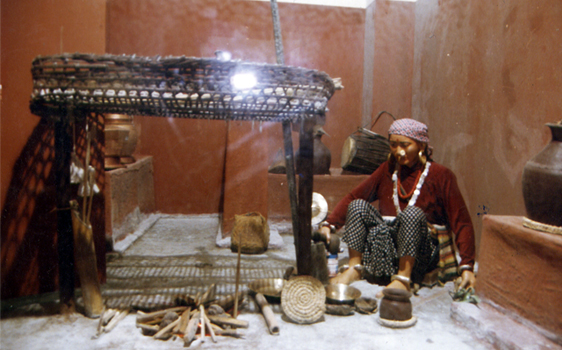
In ancient times, when Gautam Buddha came to the Kathmandu Valley—then known as Kirat Desh (the land of the Kirats) in the Himalayan region—he made 1,350 disciples here. This was about 2,500 years ago (around 520 BCE), during the rule of Kirat kings. Although the Kirat rulers and people showed respect and tolerance toward Buddha’s teachings and followers, they themselves remained firmly devoted to their own Kirat religion. This quality of tolerance is still found among Kirat followers today.
From this perspective, the Kirat religion is considered one of the oldest religions in the world, existing since the origin of the Kirat people themselves. Like Hinduism, it cannot be precisely defined in a single phrase; instead, its characteristics can be described. Its main features include:
- Absence of idol worship
- Worship of nature such as fire (hearth), land, rivers, etc.
- No discrimination based on caste or untouchability
- Equality among all humans regardless of gender
- The Mundhum as its primary scripture
A key practice of the Kirat religion is establishing a sacred place called Sangbhe (shrine or altar) under the open sky without idols, where worship is performed. In these places, the omnipresent, all-powerful God, along with ancestral deities, is invoked. Nowadays, some Sangbhe have taken the form of Kirati-style temples called Manghim.
Kirat followers also widely worship nature. Like many ancient cultures, they worship elements such as fire, water, sun, land, mountains, and crops (especially during Ubhauli and Udhauli festivals). Therefore, followers do not need to travel abroad for pilgrimage—their sacred sites are within nature itself.
Core Philosophy
The central principle of the Kirat religion is:
“All humans—men and women alike—are equal regardless of caste, religion, or skin color.”
However, after the end of Kirat rule in Nepal, Hindu rulers enforced laws that restricted the promotion of other religions. As a result, the simple, equality-based Kirat religion could not spread widely. Hindu texts like the Manusmriti attempted to place Kirat people within the lowest caste category (“Shudra”), but the Kirats themselves do not accept this caste system.
Mundhum
The religious scripture of the Kirat people is Mundhum, which consists of ancient oral traditions passed down through generations. It contains poetic narratives about:
- Creation of the earth, sky, and natural elements
- Origin of humans, animals, and plants
- Moral values and Kirat philosophy
Mundhum emphasizes:
- Equality among all Kirat people
- Absence of caste hierarchy
- Tolerance toward other religions
The preservation of Mundhum has largely depended on traditional priests and shamans such as Samba, Yewa/Yema, Fedangma, Hangchhamba, Nakchhong, and Nasu. They perform rituals from birth to death, including guiding the soul after death, using oral recitations in native languages.
Although many texts are now being published, Kirat religion has not yet gained strong global recognition. Therefore, sociologists often classify it as a shamanistic, Mundhum-based, nature-worshipping religion.
Related Ethnic Connections
Scholars believe that many ethnic groups in Nepal—such as Gurung, Tamang, Magar, Sherpa, Tharu, Rai, Limbu, Sunuwar, Yakkha, and others—share ancient connections with Kirat ancestry based on linguistic and anthropological studies. However, today mainly Rai, Limbu, Yakkha, and Sunuwar communities explicitly identify themselves as followers of Kirat religion.
Census Recognition
About a decade before 1991 (B.S. 2048), the national census did not even include “Kirat religion” as an option. Still, 318,389 people (1.7% of the population) identified under “other religions.” Later, Kirat religion received official recognition, and it was included in the 2001 census.
In the 1991 census, the combined population of Rai, Limbu, and Sunuwar alone was 863,680 (4.6% of the total population). Therefore, it was expected that the number of Kirat followers would significantly increase in subsequent censuses.
End.
