
Here is the English translation of your text:
The saying “Ten Rai, ten languages, one kitchen” has been prevalent in Nepali society since ancient times. This proverb proves that although the Rai people are multilingual, they are socially equal and free from discrimination in terms of values and traditions.
In the course of social development, the Kirat Rai communities have reached their present stage, and scientific studies of existing Rai languages show that about 26 languages are still alive. After conducting systematic surveys and field visits, evaluations revealed that all these languages do not have the same condition. Geographic terrain, number of speakers, competition with other ethnic groups, and lack of education have directly affected these languages.
The Kirat Rai Yayokkha Language and Literature Council conducted a five-week language survey expedition starting from Chaitra 2056 B.S. (1999–2000 AD). This survey was carried out in the districts considered the original settlement areas of the Kirat Rai people. After the field visit, a comprehensive linguistic report was prepared based on survey forms collected from various Rai-speaking villages, a 100-word Swadesh list, linguistic interaction programs held at district headquarters, and the direct experiences of the survey team members.
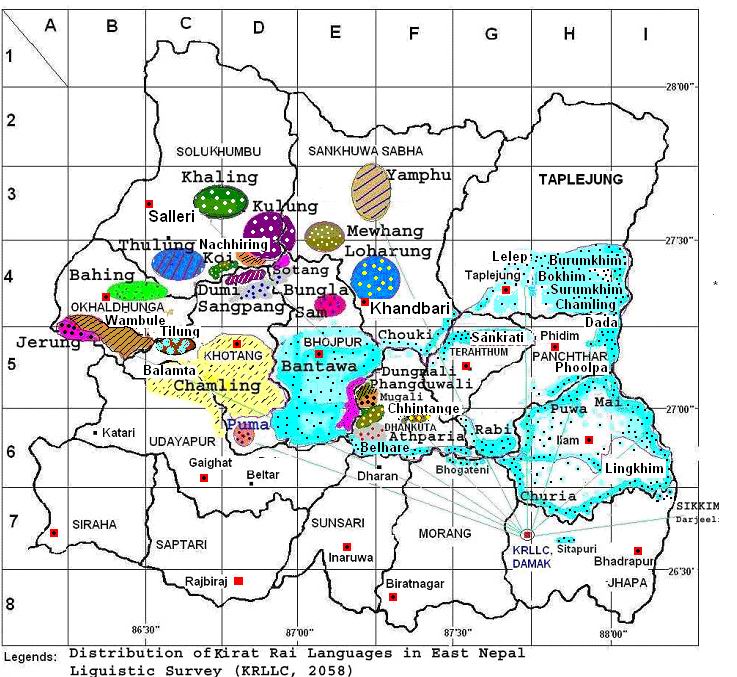
Except for Balmata in Udayapur, all Rai languages were found to be spoken in the remote eastern hills from the Sunkoshi region. Especially, the areas along the Dudh Koshi River were identified as the original homeland of Rai languages. It is estimated that most Rai languages moved eastward from these regions about two centuries ago. As Rai languages moved from west to east, questions arise as to how each language influenced or competed with others, and whether they developed or became extinct. This can be understood through a simple conceptual diagram.
It is estimated that minority languages spoken between two dominant languages may become endangered due to attraction and pressure from surrounding languages. In any case, this illustrates the origin area of Rai languages. Regardless of where Rai speakers currently live, their ancestral homeland is believed to be the same. For example, Rai languages spoken in Ilam, Panchthar, and Taplejung are believed to have originated from those ancestral regions. After field visits, it was found that Rai languages in those areas have become mixed due to interaction among different Rai-speaking groups.
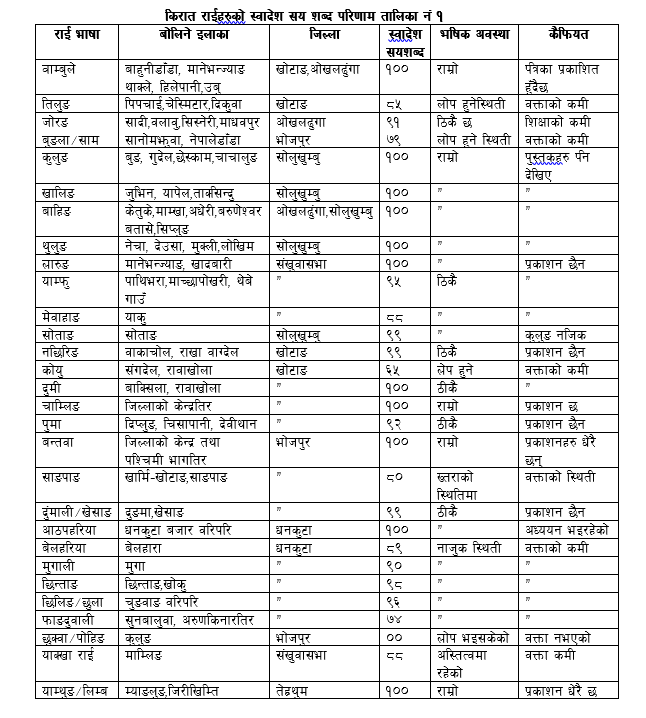
To understand the current condition of Kirat Rai languages, data was collected during the linguistic survey using a 100-word Swadesh list for most Rai languages. The preliminary results of this survey are presented in the table below. From this table, it is easy to understand which Rai language is spoken in which area and how many words from the Swadesh list are found in each language.
The above points are based on the Kirat Rai language survey report. Language problems cannot be solved overnight; linguists must work hard, and speakers themselves must also be aware of preserving their language. For the protection, promotion, and development of Rai languages, long-term plans must be formulated and continuous effort is necessary. In the past, some domestic and foreign researchers also attempted to study these languages. Although those efforts were not sufficient, they helped to pave the way for further research.
In this highly competitive modern era, if dictionaries, grammar books, and textbooks are not prepared, these valuable linguistic heritages of the nation may eventually be lost.
Nevertheless, the Kirat Rai Yayokkha Language and Literature Council is moving forward—though slowly, like a tortoise—with short-term and long-term programs. One encouraging aspect is that Tribhuvan University (TU), Nepal…
